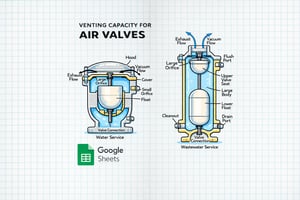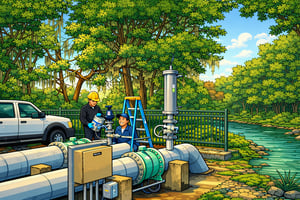

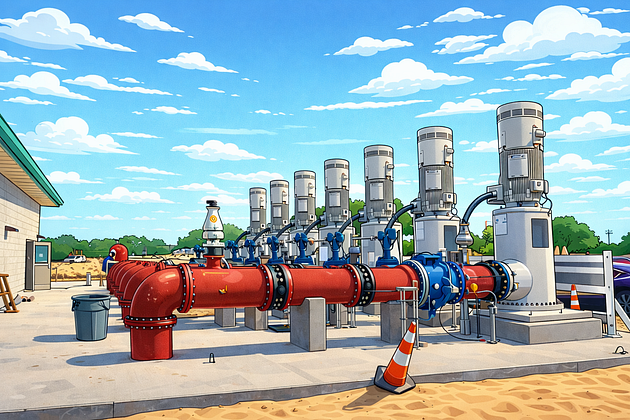
Water hammer is not random. It is the predictable result of uncontrolled acceleration. And in most...
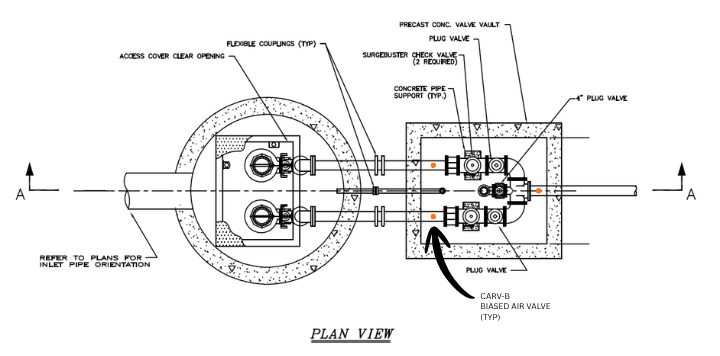
A submersible pump doesn’t wake up one day and decides to fail.
It doesn’t randomly lose performance.
It doesn’t mysteriously start pulling more amps.
And it doesn’t destroy its own bearings and seals for no reason.
Yet that’s exactly how most failures are treated.
“The pump is worn out.”
“The impeller must be damaged.”
“We need to replace the unit.”
But what if the pump isn’t the problem?
What if the system is?
The Reality Most Engineers Overlook
In wastewater lift stations, pumps don’t operate in isolation, they operate inside a dynamic hydraulic system that is constantly changing, and repeatable:
- Pumps start and stop
- Flow accelerates and decelerates
- Pressure rises and collapses
- Air enters, accumulates, compresses, and releases
According to Pumping Station Design (Revised 3rd Edition), unsteady flow conditions — particularly hydraulic transients and column separation — are critical considerations in force main design and operation.
That’s not theory.
That’s where failures are born.
Where Things Actually Go Wrong
Let’s strip this down to what really happens in a typical lift station.
1. Air Accumulates in the Force Main
Wastewater contains entrained air. It also pulls in air through:
- pump operation
- fittings and connections
- pressure fluctuations
That air doesn’t disappear.
It collects, and in wastewater can be up to 6% by volume.
2. The Pump Starts Against an Unstable System
Instead of pushing water, the pump is now pushing:
👉 water + compressible air
That changes everything:
- The system curve shifts
- Back pressure becomes unpredictable
- Flow becomes erratic
The pump is no longer operating where it was designed to.
3. Shutdown Creates Vacuum and Column Separation
When the pump shuts off:
- Flow decelerates rapidly
- Pressure drops
- The water column can separate
From a transient standpoint, this is one of the most dangerous conditions in pipeline systems.
As flow decelerates rapidly, the inertia of the moving water column continues downstream. If that momentum is not balanced by sufficient upstream pressure, the pressure in the pipeline can drop to:
- Zero gauge pressure (atmospheric)
- And in many cases, vapor pressure (near full vacuum conditions)
At this point, the liquid column can no longer remain intact.
👉 The result is column separation, a physical gap in the pipeline filled with vapor and released gases.
This is not a minor event.
According to hydraulic transient theory, once separation occurs, the system becomes unstable. When the flow reverses or the system repressurizes, the separated columns rejoin, often violently, creating damaging pressure spikes.
4. The System Rejoins — Violently
When the system repressurizes:
- Air pockets collapse or eject
- Water columns slam back together
That creates:
- surge spikes
- shock loading
- rapid pressure change (high dP)
And when the system comes back together:
👉 The energy released during rejoining is transmitted directly through the system, including back to the pump.

Where Air Valves Change the Game
Here’s the part most designs completely miss:
Air valves are not accessories.
They are transient control devices.
Upstream of the Check Valve: Controlling Air Discharge
A properly designed biased air valve upstream of the check valve:
- Controls the rate of air release
- Prevents sudden evacuation of compressed air
- Stabilizes system pressurization during startup
Without it:
- Air discharges instantly
- Water accelerates into a void
- The check valve slams
With it:
- Air is released gradually
- Pressure builds in a controlled manner
- The system stabilizes before full flow develops
Downstream of the Check Valve: Controlling Vacuum and Refill
A biased combination air valve on the discharge header performs two critical functions:
1. Breaks Vacuum
- Prevents column separation
- Protects the pipeline from collapse
- Eliminates reverse flow conditions
2. Cushions Re-Pressurization
- Allows controlled air exhaust
- Maintains an air cushion
- Reduces surge intensity
This is where most systems fail.
Not because they lack a valve, but because they lack the right valve behavior.
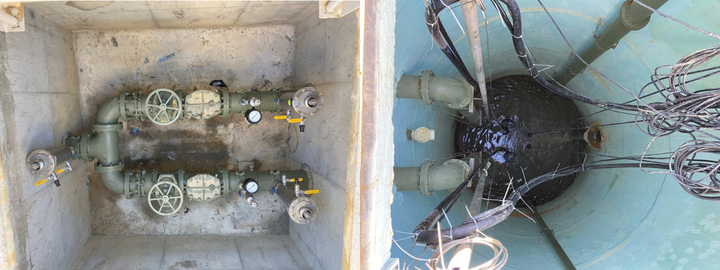
This is exactly where properly placed air valves matter:
- Downstream combination air valves admit air quickly to break vacuum
- Biased exhaust control ensures that air is not expelled too rapidly during re-pressurization
Without this control:
👉 vacuum forms → column separates → water slams back together → surge propagates → equipment takes the hit
Why “Removing Air” Is the Wrong Way to Think About It
If your design goal is:
“get the air out as fast as possible”
You are designing for failure.
Because fast air release =
👉 rapid pressure change = surge = damage
The real goal is:
👉 controlled air movement
The Pump Isn’t the Problem
When air is unmanaged, the pump experiences:
- gas binding
- off-curve operation
- reverse rotation risk
- transient loading
- repeated mechanical stress
Over time, that leads to:
- bearing failure
- seal damage
- performance loss
And eventually:
👉 replacement
The Hard Truth
Most pump failures blamed on equipment are actually:
👉 hydraulic failures caused by unmanaged air
In many force mains, the system doesn’t just lose pressure during shutdown, it reaches vacuum conditions.
If your design doesn’t account for that, you’re not controlling transients, you’re reacting to failures.
Air valves don’t protect the pump.
They control:
- pressure stability
- flow behavior
- transient response
In other words:
👉 They control the environment the pump is forced to survive in.
And if that environment isn’t controlled, it doesn’t matter how good the pump is.
For a quick helper guide to standardizing wastewater air valves, please contact us and ask for drawing FLV-1004.